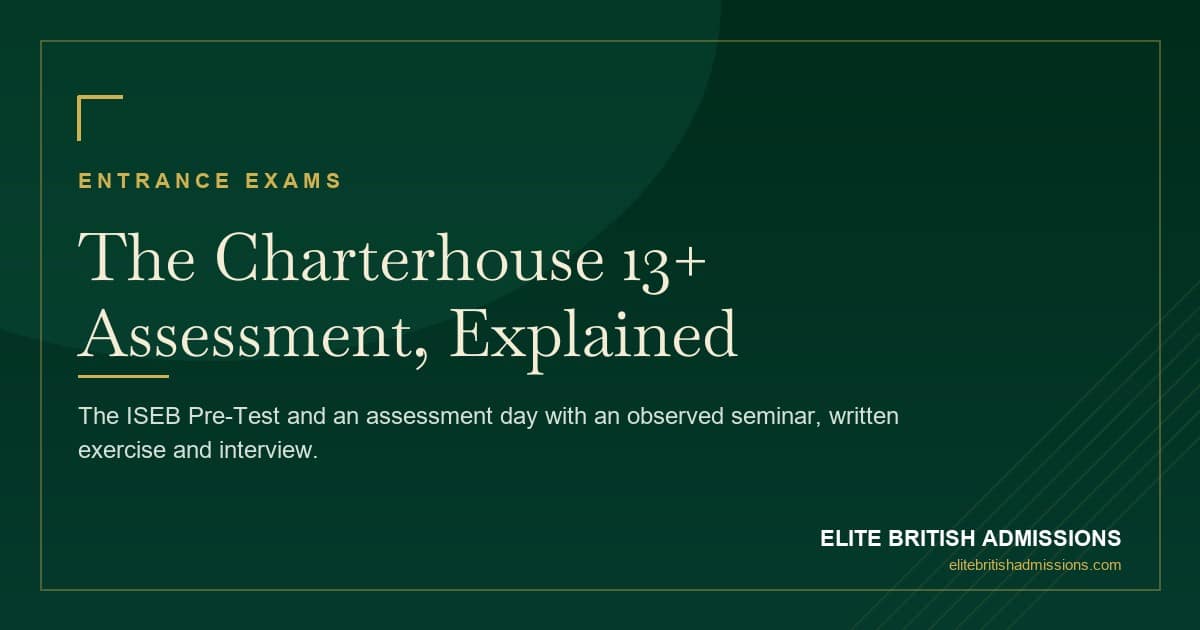
Charterhouse assesses its 13+ candidates in two stages. The first is the ISEB Common Pre-Test, taken online in the autumn term of Year 6. Shortlisted candidates are then invited to an assessment day at the school, which is unusual for including an observed seminar alongside a written exercise and a one-to-one interview. Knowing what each stage involves, and what it rewards, is the difference between focused preparation and effort spent on the wrong thing. This guide explains Charterhouse's process and how to prepare.
- First stage
- The ISEB Common Pre-Test, online in Year 6
- Pre-Test subjects
- English, Maths, Verbal Reasoning, Non-Verbal Reasoning
- Then
- A reference from the current school
- Assessment day
- An observed seminar, a written exercise and an interview
- Looking for
- Academic potential and all-round contribution
The two-stage process
Charterhouse assesses 13+ candidates in two main stages. The first is the ISEB Common Pre-Test, sat online in the autumn term of Year 6, which screens for academic potential through literacy, numeracy and reasoning. After the Pre-Test, Charterhouse requests a reference from your child's current school, and on the strength of the test and the reference it invites shortlisted candidates to an assessment day at the school. The assessment day is where Charterhouse looks beyond the test score to the whole child, through an observed seminar, a short written exercise and a one-to-one interview. Both stages matter, and they reward different things, so understanding the sequence is the first step to preparing well. Our guide to the Charterhouse interview covers the interview in detail.
The ISEB Common Pre-Test
The first stage is the ISEB Common Pre-Test, which Charterhouse candidates sit in the autumn term of Year 6. It is an online, age-standardised test, taken remotely on a digital platform from any location with an internet connection, and it covers four areas: English, Mathematics, Verbal Reasoning and Non-Verbal Reasoning. The whole test takes around two and a quarter to two and a half hours, with the sections lasting roughly forty minutes for English, forty for Maths, twenty-five for Verbal Reasoning and thirty for Non-Verbal Reasoning, and candidates can sit them together or separately. Because it is adaptive, the questions adjust to your child's answers as they go, and because it is age-standardised, it measures your child against others of exactly the same age in months, so a summer-born child is not disadvantaged. Our dedicated guide to the ISEB Common Pre-Test covers the test in full.
The assessment day
Shortlisted candidates are invited to an assessment day at Charterhouse, and this is where the school forms its fuller picture. The day combines an observed seminar, a short written exercise based on creative writing, and a one-to-one interview, alongside a guided tour and conversational activities. Charterhouse describes the purpose as uncovering each child's diverse talents and evaluating their potential all-round contribution to the school, rather than measuring exam performance alone. The day is designed to be engaging rather than intimidating, and a child who is genuinely curious, writes with imagination, and engages readily in discussion tends to do well. For a child who enjoys ideas and contributes naturally in a group, the day is a chance to show more than a screen-based test can.
The observed seminar
The observed seminar is the most distinctive part of Charterhouse's assessment, and it is worth understanding on its own. In it, candidates take part in a discussion that staff observe, looking at how a child engages with ideas, listens to others, builds on what is said, and contributes to a conversation. It is not a test of knowledge, and there is no single right answer to reach. What it rewards is a child who is genuinely interested, willing to speak up, able to listen and respond to others, and confident enough to offer a view and adjust it when they hear a good argument. This is hard to drill and easy to spot, which is exactly why Charterhouse uses it. A child who is used to discussing ideas at home, and who reads widely enough to have something to say, will engage naturally.
How to prepare
Because Charterhouse assesses in two stages that reward different things, preparation should match both. For the Pre-Test, the foundation is secure English and Maths built early, with wide reading to support comprehension, and because the test is timed, adaptive and on-screen, some online practice under realistic conditions is worth doing so the format holds no surprises. For the assessment day, the most useful preparation is the kind that builds genuine curiosity and confidence in discussion: a child who reads widely, writes for pleasure, and is used to talking about ideas and listening to others will engage naturally in the seminar, the written exercise and the interview. The written exercise rewards a child who enjoys writing and has imagination, so encouraging creative writing at home helps. Throughout, the aim is a genuinely curious child rather than a drilled one, since the assessment day is built to see past a rehearsed performance.
Give your child the best possible shot at the Charterhouse assessment
Our tutors prepare children for both the ISEB Pre-Test and Charterhouse's distinctive assessment day, including the observed seminar, with an approach that is targeted, calm and tailored to your child. Book a free diagnostic to see where they stand.
Book a free diagnosticWhat to avoid
The first thing to avoid is treating the Pre-Test as the whole assessment. It is only the first stage, and the assessment day, with its observed seminar, written exercise and interview, carries real weight in the decision. The second is over-coaching, since Charterhouse's assessment day is designed to see past a rehearsed performance, and a heavily drilled child often comes across as less genuine than a naturally curious one. The third is neglecting discussion and creative writing, both of which the assessment day rewards and neither of which responds well to drilling. Prepare for both stages, encourage genuine curiosity, and let your child's enthusiasm for ideas show.