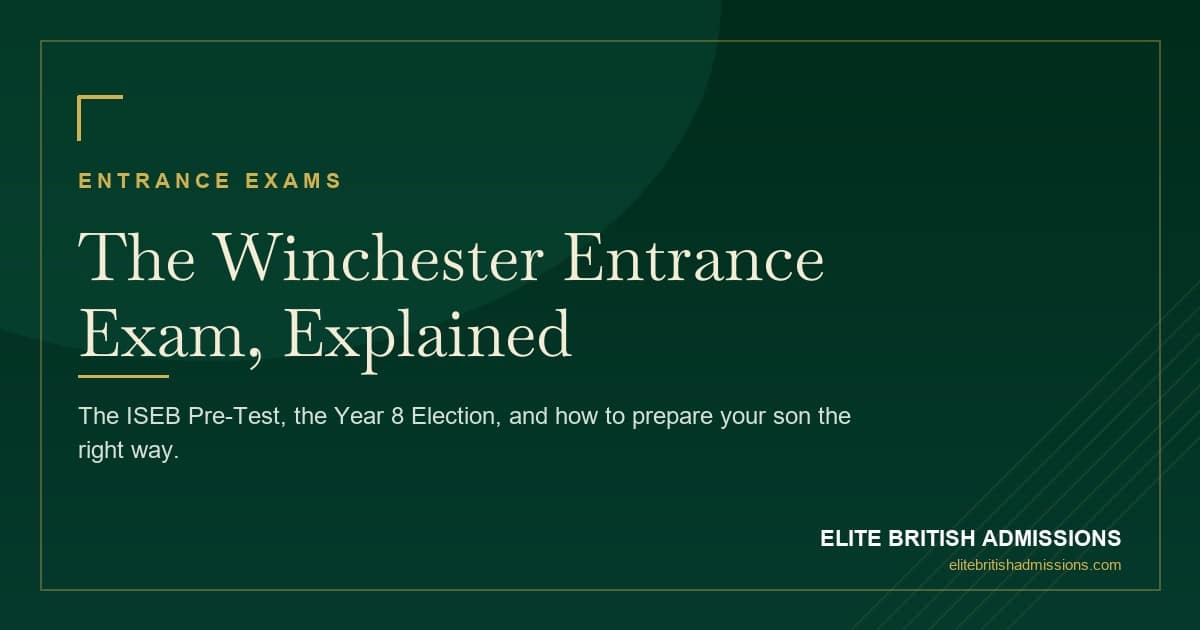
Winchester College's 13+ assessment runs across two stages, beginning in Year 6 and finishing in Year 8. Knowing the format of each stage, and what each one actually rewards, is the difference between preparation that works and preparation that wears a child out. This guide explains the ISEB Common Pre-Test, the later Winchester Entrance and Election examinations, and how to get your son ready without over-coaching him.
- Stage 1
- ISEB Common Pre-Test, sat in Year 6, online and adaptive
- Subjects
- English, Maths, Verbal Reasoning, Non-Verbal Reasoning
- Total time
- About 2 hours 15 minutes
- Stage 2
- Winchester Entrance or Election, sat in Year 8, paper-based
- Interview
- 45 minutes, January to March of Year 6
Stage 1: the ISEB Common Pre-Test
The first hurdle is the ISEB Common Pre-Test, which your son sits in Year 6. It is the same standardised, online test that many leading senior schools use as an early screen, so boys usually take it once and have their results shared with several schools at the same time. For Winchester it acts as the gate: do well, and your son moves on to the school's own later assessment and interview; fall short, and the process generally ends here.
Because the test is age-standardised, it measures your son against other children of exactly the same age in months. A summer-born boy is therefore not disadvantaged against an older classmate, which matters at this age when a few months of development can make a visible difference. Our dedicated guide to the ISEB Common Pre-Test covers the test in full. The summary below focuses on what matters specifically for Winchester.
Pre-test format and timings
The pre-test is taken on a computer and covers four sections. The approximate timings are set out below.
| Section | Time | What it tests |
|---|---|---|
| English | 40 min | Comprehension, grammar, spelling and vocabulary |
| Mathematics | 40 min | Curriculum maths and applied problem-solving |
| Verbal Reasoning | 25 min | Logic and reasoning with words |
| Non-Verbal Reasoning | 30 min | Pattern, sequence and spatial reasoning |
| Total | ~2h 15m | Usually sat in one sitting, sometimes split across two |
Stage 2: Winchester Entrance and Election
Boys who succeed at pre-test and interview receive a conditional offer, but the process is not finished. The final assessment is sat in Year 8, and it takes one of two forms. The first is Winchester Entrance, the standard final assessment, made up of school-written, paper-based examinations that confirm the conditional offer. The second is Election, Winchester's competitive scholarship examination, which the most academically able candidates take instead of Winchester Entrance. Election runs over three days in April or May of Year 8 and combines demanding written papers with interviews.
Put simply, every boy sits a final assessment in Year 8, and the strongest candidates choose the Election route in pursuit of a scholarship. Our guide to the Election scholarship covers that route in depth. For the wider context of how 13+ assessments work across schools, our guide to 13+ Common Entrance explains the system more generally.
How to prepare
Winchester is looking for real academic ability and genuine curiosity, not a child who has been coached until his interest in learning has drained away. Preparation that works is steady and broad rather than intense and narrow.
The foundation is secure maths and English built early, in Years 4 and 5, which matters far more than last-minute cramming in Year 6. Reasoning improves with familiarity, so short, frequent sessions on verbal and non-verbal reasoning are more effective than occasional long ones. Wide reading helps everywhere: Winchester rewards boys who read for pleasure across fiction and non-fiction, and it shows in both the English paper and the interview. Finally, because the pre-test is timed, adaptive and on-screen, a boy who has only ever worked on paper can be thrown by the format, so some online, timed practice is worth doing before the real thing.
Building a sensible preparation plan
A good plan starts gently and builds. In Year 4 and the first half of Year 5, the aim is simply to make sure the fundamentals are secure and that your son enjoys reading. From the second half of Year 5, light, regular reasoning practice can begin alongside continued reading. The autumn of Year 6 is when focused pre-test practice makes sense, under timed conditions and on screen. After the pre-test and interview, attention shifts to keeping momentum through Years 7 and 8 toward the final assessment, with any scholarship preparation layered in for boys aiming at Election. The mistake to avoid is front-loading everything into a frantic few months in Year 6, which tends to produce anxious children rather than ready ones.
Give your son the best possible shot at the Winchester assessment
Our tutors prepare boys specifically for the ISEB Pre-Test and the Winchester Entrance and Election stages, with an approach that is targeted, calm and tailored to your son. Book a free diagnostic to see where he stands.
Book a free diagnosticWhat to avoid
The first thing to avoid is over-coaching. Winchester's interviewers are skilled at spotting a rehearsed child, and heavy drilling can lift a pre-test score while undermining the interview, where authenticity counts for a great deal. The second is neglecting reasoning. Many families pour their effort into maths and English and treat reasoning as an afterthought, yet it makes up half of the pre-test. The third is treating a conditional offer in Year 6 as the finish line. The final assessment is still two years away, and a boy who eases off after the early stages can find himself caught out in Year 8.